
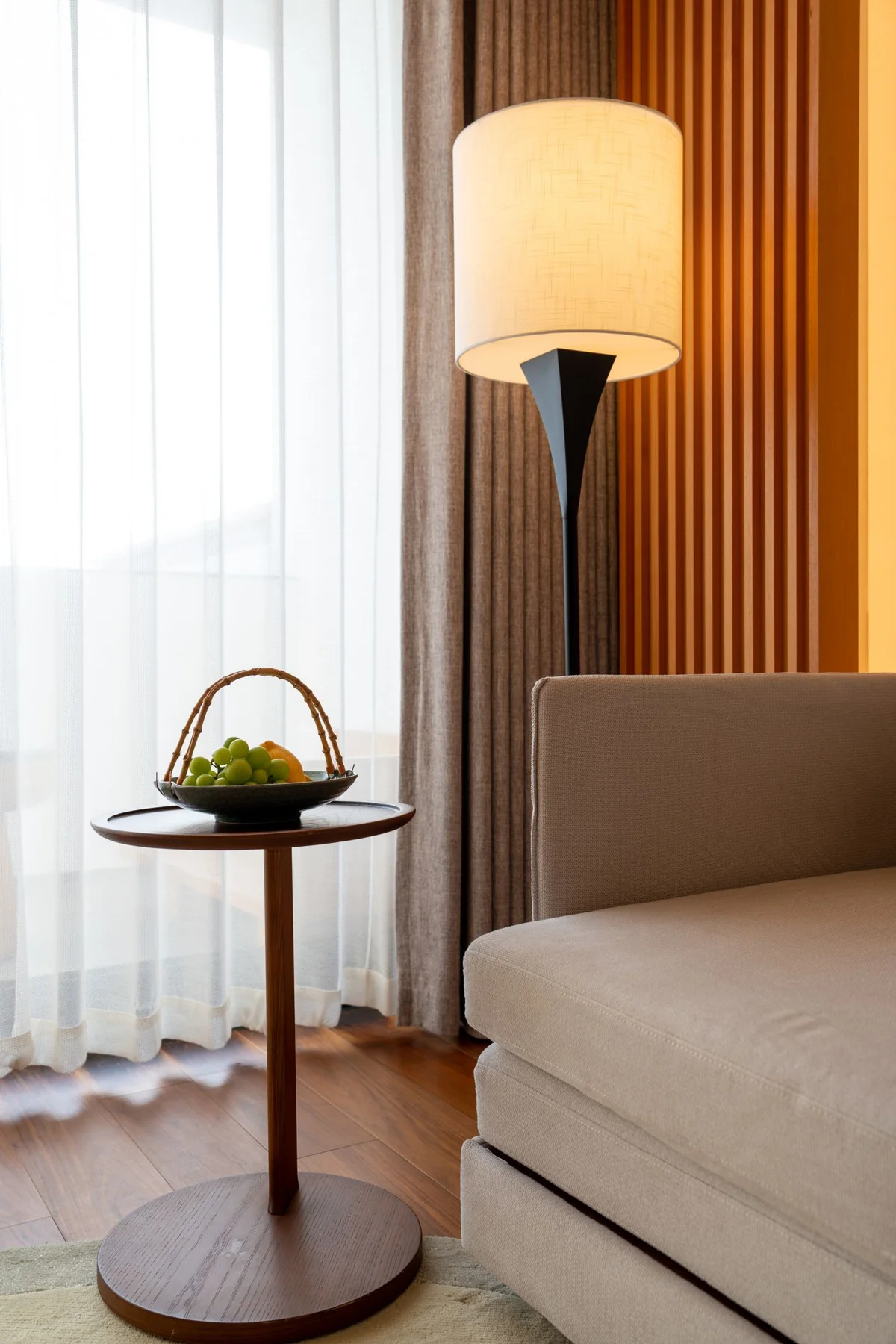
A side table should make putting down a cup easier. If the person has to twist around an arm or move a vase first, the surface is not doing its main job. Start from the actual seat, with a small clear group of ordinary items. A compact table can be enough when it is positioned well. More area is less useful if its legs block the route or its height makes the simplest movement awkward.
Try an existing table first
Use a stable suitable surface to compare positions. Sit back naturally and reach towards an empty cup. Check the effect of the chair or sofa arm. Matching the arm's height visually does not establish comfortable reach for every person. Try the neighbouring seat if the table will be shared. Avoid fragile stacks or unstable supports as an experiment; the test should remain straightforward and safe.
Measure what touches the floor
Check legs and base as well as the top. A small circular surface may stand on a broad support. If a design slides over the seat, compare its requirements with actual under-furniture clearance. Include rugs and uneven flooring. Follow loading guidance and use the table only for its intended role. An occasional surface is not a step or an automatic support for heavy items.
Decide what belongs there
Name the main function: drink, current reading or lamp. Try the actual objects and leave enough room to set one down without balancing it at an edge. A lamp base can occupy the entire useful area. Consider another suitable light position before adding another crowded table. One practical item and clear space can be a complete arrangement.
Walk through the room normally
Pass the table carrying an ordinary bag or laundry basket and check nearby doors or drawers. Assess the seat occupied as well as empty. Rounded edges do not remove the need for suitable clearance and stability. If the table repeatedly catches clothing or narrows an important route, change the footprint or position instead of expecting everyone to remember a careful detour.
Choose manageable surface care
Read finish guidance for condensation, warm objects and spills. Use suitable protection where required. A delicate surface can be enjoyable when its care is chosen knowingly. Keep the top clear enough to maintain without several temporary piles. A tray can gather a useful group, but a heavy decorative arrangement on a tray may make cleaning harder than separate simple objects.
Must it match the coffee table?
No. A shared material or scale can be enough if desired, while different tables serve different roles. Live with a borrowed position for several evenings where practical. The successful table stays reachable and stable, giving everyday objects a clear place without making the room work around another purchase selected mainly to complete a styled view.
Related reading
A Warm, Collected Living Room Without Starting Again, A Small Breakfast Table with Enough Useful Surface.